
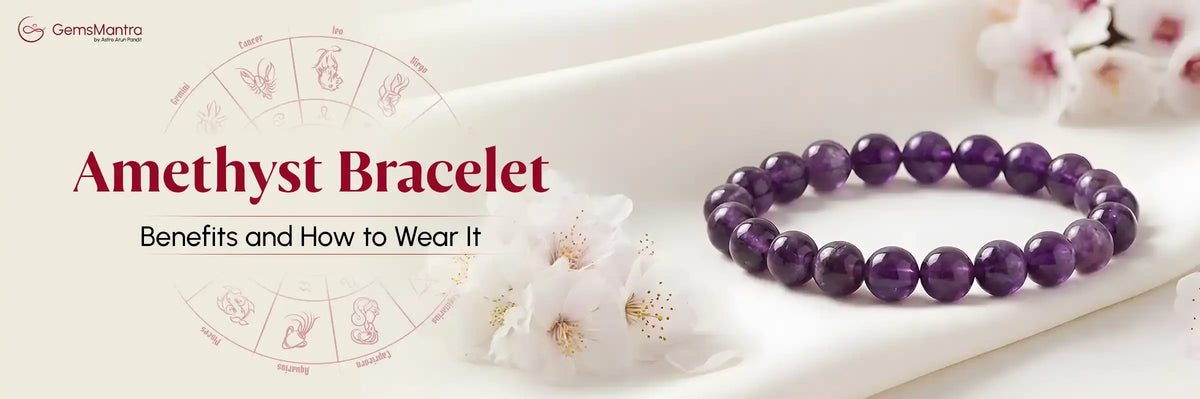
Amethyst Bracelet: Benefits and How to Wear It
Quick answer: An amethyst bracelet is a string of polished amethyst (Jamunia) beads, the purple variety of quartz. In crystal tradition it is worn for calm, focus and a quieter mind, and in jyotish it is a substitute stone (upratna) for Neelam, the stone of Shani. These are traditional beliefs, not promised results. Most people wear it on the left wrist; check for natural colour zoning, not flat dyed colour.

Key takeaways
- Amethyst is purple quartz, 7 on the Mohs scale, so it suits everyday wear.
- Crystal tradition links it with calm, clarity and restful evenings; jyotish uses it as an upratna for Neelam (Shani).
- Most people wear it on the left wrist; Saturday is the traditional first day because of the Shani link.
- Real amethyst usually shows uneven purple bands. Perfectly flat colour and round bubbles point to dye or glass.
- Strong sunlight can fade amethyst over time, so do not leave it on a sunny windowsill.
What is an amethyst (Jamunia) bracelet?
Amethyst is the purple variety of quartz. Its colour comes from traces of iron in the crystal together with natural radiation in the ground, which is why shades range from pale lilac to deep violet. In Hindi it is called Jamunia (also written Jamuniya), after the colour of the jamun fruit. The name amethyst comes from the Greek amethystos, “not intoxicated”, because the ancient Greeks believed it kept the wearer clear-headed.
An amethyst bracelet strings round amethyst beads on a stretch cord. Our amethyst bracelet is available with 8 mm or 10 mm beads. If you want a faceted stone for a ring or pendant instead, see the loose stones in our Amethyst (Jamunia) collection, and read our full guide to amethyst benefits and who should wear it.
Amethyst bracelet benefits in crystal tradition and jyotish
Amethyst has two traditions behind it. Crystal practice links it with the crown and third-eye chakras and with a calmer mind. Vedic jyotish uses it as an affordable upratna for Neelam (blue sapphire), the stone of Shani (Saturn). Here is what each tradition associates with it:
| Area | Traditional association | Keep in mind |
|---|---|---|
| Calm | Worn to feel settled and less restless | Not a treatment for stress, anxiety or sleep problems |
| Focus and clarity | Kept on during study, prayer or meditation | A symbolic cue to slow down |
| Shani (Saturn) | Upratna for Neelam, considered milder and safer to try | Ask your astrologer if Saturn suits your chart |
| Spiritual practice | Linked with intuition and the crown chakra | A personal, belief-based choice |
| Letting go of habits | The Greek “not intoxicated” legend | Folklore, not a remedy |
People often choose an amethyst bracelet as a gentler way to work with Saturn than Neelam, which tradition treats with more caution. Our guide to substitutes for Neelam compares amethyst with iolite and other options.
How to wear an amethyst bracelet
- Choose the wrist. Crystal tradition treats the left hand as the receiving side, so most people wear amethyst on the left wrist for calm. The right wrist is also fine; there is no fixed rule.
- Pick the day. Because of its Shani link, many people put it on first on a Saturday, often in the evening.
- Cleanse it. Rinse it briefly in clean water or rest it on a clean cloth overnight. Avoid leaving it in sunlight to “charge”, because amethyst can fade.
- Set an intention. Hold it for a minute and think of what you want to feel calmer or clearer about. A Shani mantra such as “Om Sham Shanicharaya Namah” is optional.
- Wear it daily. Take it off for bathing, swimming, exercise and before applying perfume or creams, to protect the cord.

How to tell natural amethyst from dyed or glass beads
Amethyst is not rare, but cheap bracelets are often made of dyed quartz, dyed jade or plain glass. Use these checks before you buy:
 Sample image
- Colour zoning: hold a bead up to daylight. Natural amethyst often shows lighter and darker purple bands or patches. Glass and dyed beads look flat and identical.
- Dye in cracks: dyed beads collect darker colour along cracks and around the drill hole.
- Bubbles: tiny round bubbles inside a bead mean glass. Quartz can have natural wisps and lines, but not round bubbles.
- Feel: quartz stays cool against the skin for longer than glass or plastic.
- A report number: every GemsMantra order ships with a GemsMantra Authenticity Report, and you can enter its number on our Check Certificate page. GemsMantra works with leading labs including GIA, IGI, GRS and GJEPC's IIGJ. Each stone's listing names the lab that issued its report and the report number.
For more on reading a report, see how to verify a gemstone certificate.
Who wears amethyst, and what to pair it with
Crystal tradition treats amethyst as a gentle stone suitable for most people. It is popular with students, people in demanding jobs, and anyone who meditates. In jyotish it is usually suggested when Saturn is important in the chart, for example during Shani's mahadasha or Sade Sati, and for people born under Makar (Capricorn) or Kumbh (Aquarius), the two signs ruled by Saturn. If you are not sure, our free bracelet calculator suggests bracelets from your date of birth.
- Amethyst with lapis lazuli for calm communication; see lapis lazuli benefits.
- Amethyst with rose quartz for a soft, calming combination; see our rose quartz bracelet guide.
- Amethyst with 7 Mukhi Rudraksha, a common pairing in bracelets made for Saturn periods.
- Amethyst with a Neelam ring: both relate to Saturn, so ask your astrologer before doubling up.
Care and what to check before you buy
| Check | What good looks like |
|---|---|
| Stone named clearly | “Natural amethyst (quartz)”, not “purple crystal” or “amethyst colour” |
| Colour | Natural zoning or slight variation between beads |
| Bead size | 8 mm for a daily look, 10 mm for a bolder one |
| Report | A report number you can check online |
| Return terms | At GemsMantra, bead bracelets and malas are not returnable for a change of mind; damaged, defective or incorrect items are covered |
Care: amethyst can lose colour after long exposure to strong sunlight or heat, so store it in a drawer or pouch, not on a sunny windowsill. Wipe it with a soft damp cloth and let it dry before wearing. Keep it apart from harder stones such as sapphire, which can scratch it. Read our refund policy before you order, and see how to wear an amethyst gemstone if you are choosing a ring instead.
Frequently asked questions
Which hand should I wear an amethyst bracelet on?
Most people wear it on the left wrist, which crystal tradition treats as the receiving side. The right wrist is also fine; there is no single rule.
What is amethyst called in Hindi?
Amethyst is called Jamunia (also written Jamuniya) in Hindi, after the purple colour of the jamun fruit.
Can I wear an amethyst bracelet every day?
Yes. Amethyst is 7 on the Mohs scale and handles daily wear. Remove it for bathing and exercise to protect the cord, and keep it out of strong sun.
Is amethyst a substitute for Neelam?
In jyotish, amethyst is a common upratna (substitute stone) for Neelam, the stone of Shani. Tradition considers it milder, but ask your astrologer before using it for Saturn.
How do I know if my amethyst bracelet is real?
Look for natural colour zoning, no dye collecting in cracks and no round bubbles. Ask for a report number you can verify.
Does amethyst fade in sunlight?
It can. Long exposure to strong sunlight or heat can lighten amethyst, so store it away from sunny windows.
Can I sleep wearing an amethyst bracelet?
Many people do, and crystal tradition links amethyst with calm. Remove it if the cord feels tight, and remember it is not a sleep treatment.
Related reading
Choose your amethyst bracelet
Natural amethyst beads in 8 mm and 10 mm, with a report number you can check.
Free guidance on WhatsApp: +91 92178 46751 (Monday to Saturday, 10am to 7pm IST)
Spiritual and astrological associations described here come from traditional Vedic belief and crystal tradition. GemsMantra products are not medicines, and no specific outcome is guaranteed.
Written by Shruti Tiwari


%20beads,%20the%20purple%20variety%20of%20quartz.%20In%20crystal%20tradition%20it%20is%20worn%20for%20calm,%20focus%20and%20a%20quieter%20mind,%20and%20in%20jyo...)


![Amethyst (Jamunia) – 6.45 Carat / 7.1 Ratti [GM09287]](http://gemsmantra.com/cdn/shop/files/GM09287_Front_263e492b-969f-408b-8f86-ea9854b84a62.jpg?v=1790666502&width=2000)
![Amethyst (Jamunia) – 6.45 Carat / 7.1 Ratti [GM09287]](http://gemsmantra.com/cdn/shop/files/preview_images/b08157e187a84661ac75bf0a3a6e3f09.thumbnail.0000000000.jpg?v=1786969642)
![Amethyst (Jamunia) – 9.61 Carat / 10.6 Ratti [GM09286]](http://gemsmantra.com/cdn/shop/files/GM09286_Front_d0cbfaf1-7f7a-47f0-adb1-151abc1d27b4.jpg?v=1790666168&width=2000)
![Amethyst (Jamunia) – 9.61 Carat / 10.6 Ratti [GM09286]](http://gemsmantra.com/cdn/shop/files/preview_images/f5748f3f0a2f4ea48c1d243c7656d4d1.thumbnail.0000000000.jpg?v=1786969635)
![Amethyst (Jamunia) – 6.42 Carat / 7.1 Ratti [GM09283]](http://gemsmantra.com/cdn/shop/files/GM09283_Front_410282c1-674e-4322-bdd5-0069a97b59ab.jpg?v=1790666091&width=2000)
![Amethyst (Jamunia) – 6.42 Carat / 7.1 Ratti [GM09283]](http://gemsmantra.com/cdn/shop/files/preview_images/b47e2d204e044e3a9e230081bb1bcf51.thumbnail.0000000000.jpg?v=1786969597)
![Amethyst (Jamunia) – 8.12 Carat / 8.9 Ratti [GM09281]](http://gemsmantra.com/cdn/shop/files/GM09281_Front_b069dbe8-4f79-4167-a0c4-2b6346709c1f.jpg?v=1790666008&width=2000)
![Amethyst (Jamunia) – 8.12 Carat / 8.9 Ratti [GM09281]](http://gemsmantra.com/cdn/shop/files/preview_images/bb89b66577574c9d8d4d6cceb36d66d8.thumbnail.0000000000.jpg?v=1786969568)
![Amethyst (Jamunia) – 6.77 Carat / 7.4 Ratti [GM09280]](http://gemsmantra.com/cdn/shop/files/GM09280_Front.jpg?v=1790665971&width=2000)
![Amethyst (Jamunia) – 6.77 Carat / 7.4 Ratti [GM09280]](http://gemsmantra.com/cdn/shop/files/preview_images/54388ded644e4517a5541ad2b01cf2bc.thumbnail.0000000000.jpg?v=1786969566)
![Amethyst (Jamunia) – 5.78 Carat / 6.4 Ratti [GM09279]](http://gemsmantra.com/cdn/shop/files/GM09279_Front_596b6b5a-6de0-42d3-9da4-9dbc0c18386d.jpg?v=1790665913&width=2000)
![Amethyst (Jamunia) – 5.78 Carat / 6.4 Ratti [GM09279]](http://gemsmantra.com/cdn/shop/files/preview_images/6abea8198fca43eda1aa1621ace83d9e.thumbnail.0000000000.jpg?v=1786969546)
![Amethyst (Jamunia) – 10.43 Carat / 11.5 Ratti [GM09277]](http://gemsmantra.com/cdn/shop/files/GM09277_Front_ce7c4d04-31a3-44d1-8b44-a5024f8cef00.jpg?v=1790665291&width=2000)
![Amethyst (Jamunia) – 10.43 Carat / 11.5 Ratti [GM09277]](http://gemsmantra.com/cdn/shop/files/GM09277_Back_2e6f06aa-5b84-43cd-b86a-02fdc73e49b8.jpg?v=1790665291&width=2000)
![Amethyst (Jamunia) – 7.21 Carat / 7.9 Ratti [GM09276]](http://gemsmantra.com/cdn/shop/files/GM09276_Front_f4e5cbbd-8031-466d-ae18-5988f9b818bc.jpg?v=1790665877&width=2000)
![Amethyst (Jamunia) – 7.21 Carat / 7.9 Ratti [GM09276]](http://gemsmantra.com/cdn/shop/files/preview_images/9f1479df9c0940d6bf875fa76963781f.thumbnail.0000000000.jpg?v=1786969523)
![Amethyst (Jamunia) – 8.22 Carat / 9 Ratti [GM09275]](http://gemsmantra.com/cdn/shop/files/GM09275_Front_88abe21d-0f36-49d2-bb6a-89571c8a7200.jpg?v=1790665789&width=2000)
![Amethyst (Jamunia) – 8.22 Carat / 9 Ratti [GM09275] – view 2](http://gemsmantra.com/cdn/shop/files/GM09275_HAND_19fd14df-6fbb-4783-9ea6-1a180eca33fc.jpg?v=1783074944&width=1600)
![Amethyst (Jamunia) – 7.02 Carat / 7.7 Ratti [GM09274]](http://gemsmantra.com/cdn/shop/files/GM09274_Front_13c18e19-158a-4139-af2a-f3184bb7b5dd.jpg?v=1790665748&width=2000)
![Amethyst (Jamunia) – 7.02 Carat / 7.7 Ratti [GM09274]](http://gemsmantra.com/cdn/shop/files/preview_images/3e192b77b8114fe4b38ae0f17b884744.thumbnail.0000000000.jpg?v=1786969504)
![Amethyst (Jamunia) – 6.78 Carat / 7.5 Ratti [GM09273]](http://gemsmantra.com/cdn/shop/files/GM09273_Front.jpg?v=1790665703&width=2000)
![Amethyst (Jamunia) – 6.78 Carat / 7.5 Ratti [GM09273]](http://gemsmantra.com/cdn/shop/files/preview_images/a6f969a247384a1cb59f29e4faf5b389.thumbnail.0000000000.jpg?v=1786969499)
![Amethyst (Jamunia) – 6.69 Carat / 7.4 Ratti [GM09271]](http://gemsmantra.com/cdn/shop/files/GM09271_Front_85ec32cf-118c-435e-8b4a-b7a9c212c2a5.jpg?v=1790665657&width=2000)
![Amethyst (Jamunia) – 6.69 Carat / 7.4 Ratti [GM09271]](http://gemsmantra.com/cdn/shop/files/preview_images/279c19ec369b45bb81c6ac7d435704a5.thumbnail.0000000000.jpg?v=1786969477)
![Amethyst (Jamunia) – 5.97 Carat / 6.6 Ratti [GM09268]](http://gemsmantra.com/cdn/shop/files/GM09268_Front_fb269730-39b8-4d05-b476-22b2ca064e94.jpg?v=1790665616&width=2000)
![Amethyst (Jamunia) – 5.97 Carat / 6.6 Ratti [GM09268]](http://gemsmantra.com/cdn/shop/files/preview_images/bcb9db6c49d54a29840fe34b8dd6c35f.thumbnail.0000000000.jpg?v=1786969436)
![Amethyst (Jamunia) – 16.1 Carat / 17.7 Ratti [GM09553]](http://gemsmantra.com/cdn/shop/files/GM09553_Front_730f4d30-5ee1-4fd4-b3b3-67df94b0b781.jpg?v=1790665363&width=2000)
![Amethyst (Jamunia) – 16.1 Carat / 17.7 Ratti [GM09553]](http://gemsmantra.com/cdn/shop/files/GM09553_Back_de7483d4-db61-4a76-a171-5eabf2538eb4.jpg?v=1790665363&width=2000)
![Amethyst (Jamunia) – 23.4 Carat / 25.7 Ratti [GM09554]](http://gemsmantra.com/cdn/shop/files/GM09554_Front_efc66a2c-f40c-48f2-b4c9-0a462b8b879e.jpg?v=1790665446&width=2000)
![Amethyst (Jamunia) – 23.4 Carat / 25.7 Ratti [GM09554]](http://gemsmantra.com/cdn/shop/files/GM09554_Back_f69c2b82-0369-4379-a8eb-4564fc171a7b.jpg?v=1790665446&width=2000)

