
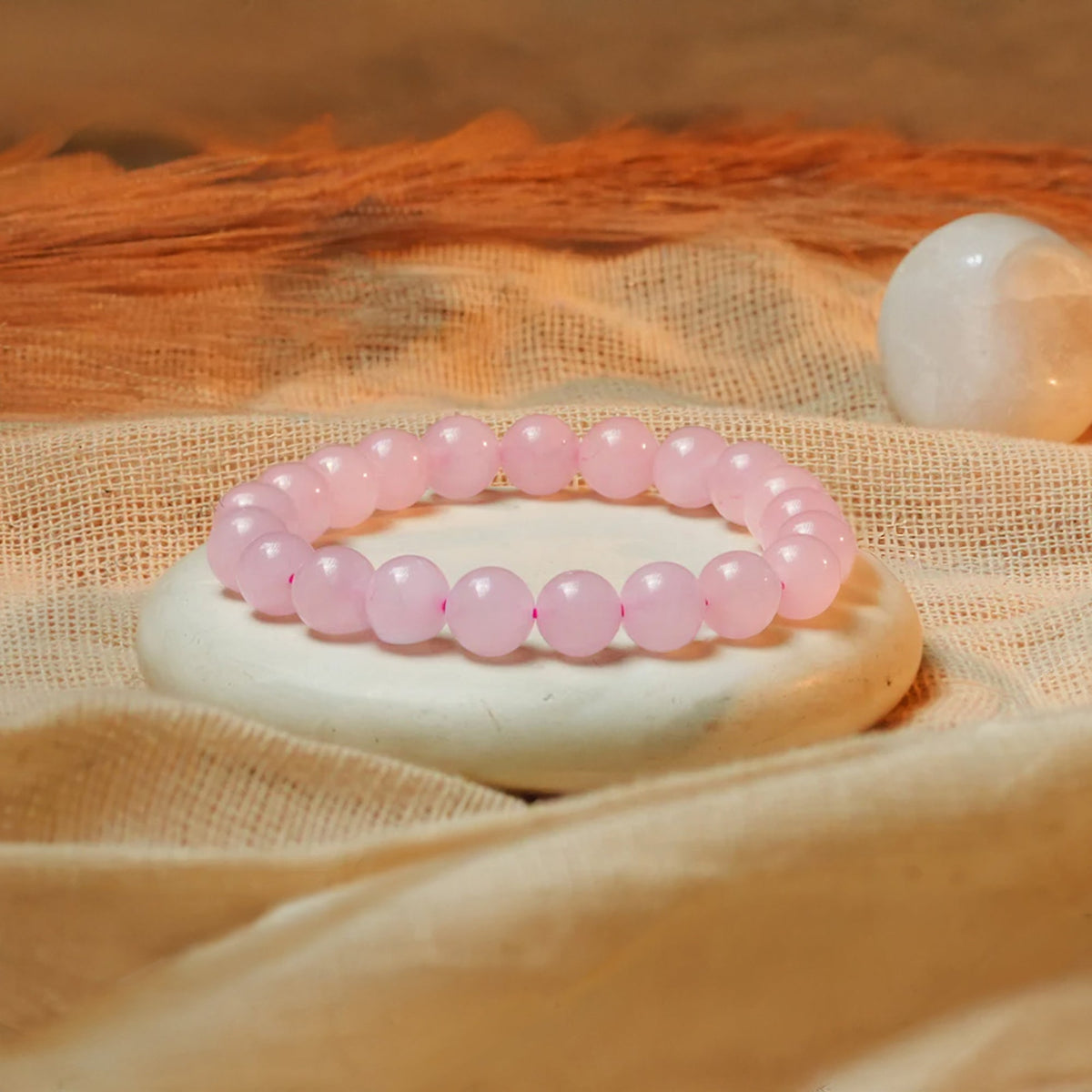
Rose Quartz Bracelet: Benefits, Meaning & How to Wear
Quick answer: A rose quartz bracelet is worn in crystal tradition for love, self-worth, compassion and emotional calm; rose quartz is the stone of the heart chakra. It is usually worn on the left wrist (the receiving side), and many people first put it on on a Friday, the day linked with Venus. Women and men can both wear it. These are traditional beliefs, not promised outcomes, and natural rose quartz is a soft, slightly cloudy pink, never candy-bright.
Rose Quartz is the soft pink variety of quartz, and the best-known crystal for love — of others and of yourself. In crystal tradition it is worn to open the heart, soothe emotional heaviness, soften relationships and build self-worth. It is the stone of the heart chakra, and is often given as a gift between partners, friends and family. This guide explains what rose quartz is worn for, who it suits, how to wear it, and how to tell a natural stone from a dyed one.
If love, self-acceptance or calming after a difficult time is what you are looking for, rose quartz is the gentle, classic choice — less about money or power, more about the heart.
What rose quartz is traditionally worn for
| Area | Traditional association |
|---|---|
| Love & relationships | Attracting and deepening love; softening conflict |
| Self-worth | Self-acceptance, compassion toward oneself |
| Emotional balance | Comfort after heartbreak, grief or stress |
| Heart chakra | Opening and balancing the Anahata (heart) chakra |
Rose quartz bracelet meaning
A rose quartz bracelet stands for love in its widest sense: love for a partner, for family and friends, and for yourself. That is why it is a popular gift, and why people wear it after heartbreak or during stressful periods as a daily reminder to be gentle with themselves. In Hindi it is simply called rose quartz, or gulabi sphatik (pink crystal).
Who should wear rose quartz
Rose quartz is gentle and suits almost anyone — those seeking love or wanting to strengthen an existing relationship, anyone calming from emotional pain, and those who simply want to be kinder to themselves. It is also one of the most popular crystals to gift, precisely because of its loving associations.
How to wear rose quartz
For drawing in love and compassion, rose quartz is worn as a bracelet on the left wrist — the receiving side. Some keep a piece in the bedroom or carry a small tumbled stone through difficult days. Wear it consistently and set a clear intention.
Rose quartz is the crystal of the open heart — worn as much for self-love as for romance.
Which hand and which day to wear a rose quartz bracelet
 Sample image
Crystal tradition treats the left hand as the receiving side, so a rose quartz bracelet worn to draw in love and compassion goes on the left wrist, for women and men alike. Some people wear it on the right wrist when their intention is to give love and kindness to others; either is acceptable, and there is no strict rule.
There is also no fixed day, but many people start on a Friday, the day associated with Venus (Shukra), the planet of love and relationships. To wear it for the first time, cleanse it (moonlight, sage smoke or a brief rinse), hold it for a moment while you set a simple intention, then put it on and wear it daily.
| Question | Traditional answer |
|---|---|
| Which hand? | Left wrist to receive love; right wrist if your intention is to give it |
| Which day? | Any day; many start on a Friday (Venus) |
| First time? | Cleanse, set an intention, then wear it daily |
| Women or men? | Both; the associations are the same |
Cleansing and care
Cleanse rose quartz with moonlight, sage smoke or a brief rinse under clean water. Avoid long, direct sunlight, which can fade its delicate pink. Keep it away from perfume and harsh chemicals.
Rose quartz bracelet price (our catalogue, 24 September 2026)
| Bracelet | Listed price |
|---|---|
| Rose Quartz Bracelet | ₹1,149 |
| Natural Rose Quartz Bracelet | ₹1,499 |
| Kark (Cancer) rashi bracelet with rose quartz and 5 Mukhi rudraksha | ₹1,499 |
Prices change with stock; see the natural crystal bracelets collection for today's range, including rose quartz combinations such as rose quartz with clear quartz.
Natural vs dyed rose quartz
Natural rose quartz is usually a soft, slightly cloudy pink. Dyed quartz and glass imitations are common. How to tell:
- Colour. Natural rose quartz is a gentle, milky pink, often with faint cloudiness. Dyed stones can look an intense, candy pink.
- Clarity. Genuine rose quartz is usually translucent to slightly cloudy, rarely glass-clear; very clear, vivid pink beads may be glass.
- Bubbles. Glass imitations may contain tiny internal bubbles.
- Honest sourcing. Buy from a seller who states it is natural rose quartz and gives a report number you can verify (see how to verify a gemstone certificate).
The GemsMantra standard
Every order ships with a GemsMantra Authenticity Report with a unique report number that you can check on our Check Certificate page. GemsMantra sells natural stones only and does not sell lab-grown stones. Bead bracelets cannot be returned for a change of mind (only if damaged, defective or incorrect); see our Refund Policy.
Frequently asked questions
What are the benefits of rose quartz?
In crystal tradition, rose quartz is worn for love, self-worth and emotional balance, and is the stone of the heart chakra — softening relationships and bringing comfort and compassion.
Which hand should I wear a rose quartz bracelet on?
For drawing in love and compassion, rose quartz is traditionally worn on the left wrist, the receiving side of the body.
Is rose quartz only for romantic love?
No — it is associated with all forms of love, including self-love and compassion, which is why it is worn for balance and self-acceptance, not only romance.
How do I cleanse rose quartz?
With moonlight, sage smoke or a brief rinse under clean water. Avoid long direct sunlight, which can fade the pink.
How do I know if rose quartz is natural?
Natural rose quartz is a soft, milky pink and translucent to slightly cloudy; very clear, intensely candy-pink beads may be dyed or glass.
Which day should I wear a rose quartz bracelet?
There is no fixed rule, but many people first wear it on a Friday, the day associated with Venus (Shukra), the planet of love. After that it is worn every day.
How do I wear a rose quartz bracelet for the first time?
Cleanse it with moonlight, sage smoke or a brief rinse, hold it for a moment while you set a simple intention, then wear it on the left wrist and keep wearing it daily.
Can men wear a rose quartz bracelet?
Yes. The traditional associations (love, compassion, self-worth and calm) are the same for men and women. They are traditional beliefs, not promised results.
Wear genuine rose quartz
Honestly described, with a report number you can check. Explore the rose quartz bracelet, or the full bracelet collection.
Shop the Rose Quartz BraceletExplore braceletsRelated guides
The Best Crystal Bracelets for Wealth & Prosperity · Amethyst (Jamunia): Benefits & Who Should Wear · Citrine (Sunela): Benefits & How to Wear · Green Aventurine Benefits · Moonstone Benefits
Crystal associations described here reflect traditional and metaphysical beliefs. They are not medical advice and are not presented as guaranteed outcomes.
Written by Shruti Tiwari


Key Highlights
- What rose quartz is traditionally worn for
- Rose quartz bracelet meaning
- Who should wear rose quartz
- How to wear rose quartz
- Which hand and which day to wear a rose quartz bracelet
- Cleansing and care
- Rose quartz bracelet price (our catalogue, 24 September 2026)
- Natural vs dyed rose quartz
- Frequently asked questions


