
Real vs Fake Rudraksha: How to Tell the Difference
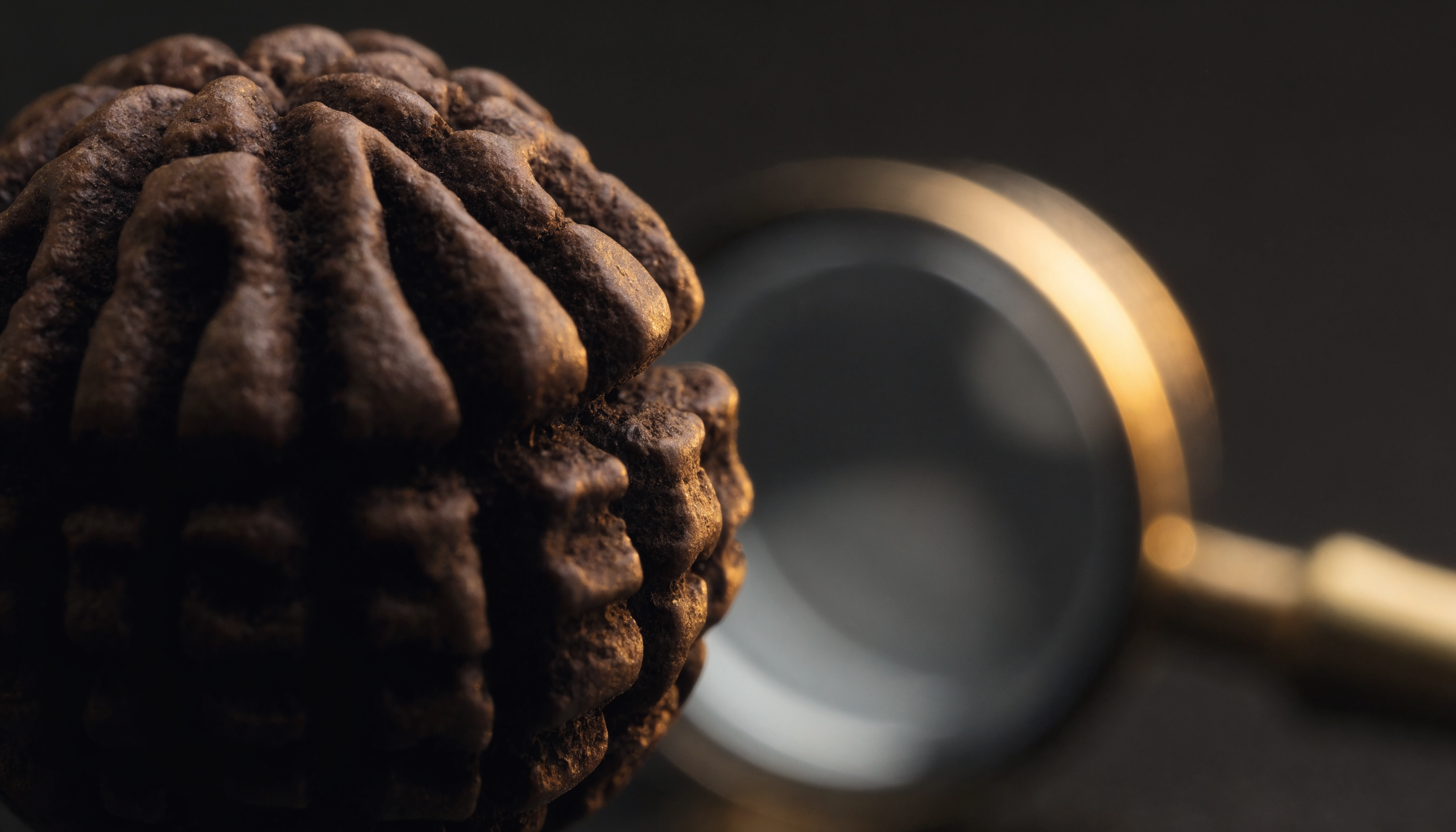
A genuine Rudraksha has natural, continuous mukhi lines and a hard, textured surface — and the only definitive way to confirm it is an X-ray, which reveals the bead's internal compartments. Most of the tests passed around online, including the famous water test, do not actually prove anything. If you want certainty, ask for a report you can verify and, for rare or high-value beads, an X-ray of the exact bead.
The Rudraksha trade has a counterfeiting problem. Demand is high, genuine high-mukhi beads are rare, and the result is a market full of imitations. The good news is that telling real from fake is not mysterious — it just requires knowing which checks to trust and which to ignore.
What fakes are actually made of
- Moulded seeds or wood shaped to look like a Rudraksha, sometimes with a coating to mimic texture.
- Carved or glued faces. Extra mukhi lines are carved — or separate pieces glued — onto a lower-mukhi bead to sell it as a rare higher one.
- Dyeing. Beads are darkened to look older and more authentic.
- Plastic or resin replicas, usually the easiest to spot by their light weight and even surface.

Which tests actually work
| Test | Reliable? | Why |
|---|---|---|
| Inspect the mukhi lines | Helpful | Real faces run unbroken end-to-end and are never perfectly even; carved lines look too regular. |
| Feel the surface & weight | Helpful | Genuine beads are hard and firmly textured; plastic feels light and smooth. |
| Water sink/float test | Myth | Density and moisture vary, so real beads can sink or float — and fakes can be weighted either way. |
| Copper-coin rotation test | Myth | Rotation depends on shape and balance, not authenticity. Folklore, not proof. |
| Boiling test | Risky & weak | Can damage a real bead and proves little either way. |
| X-ray imaging | Definitive | Reveals the internal compartments that match the number of faces. In some beads the compartments overlap and are hard to count. |
| Lab certificate | Definitive | A report with a unique number you can verify against the issuing lab. |
If a test is easy to do at your kitchen table, it is usually easy to fool. Real proof comes from an X-ray, not a bowl of water.
Why the water test refuses to die
It is the most repeated Rudraksha test online, and it is the least reliable. A genuine bead's behaviour in water depends on its density, how dry it is, and trapped air — so it may sink or float with no bearing on whether it is real. Sellers know this, and counterfeit beads are routinely weighted to pass. Treat the water test as entertainment, not evidence.
What real proof looks like
The only checks that hold up are an X-ray and a verifiable certificate. An X-ray shows the bead's internal seed chambers, which correspond to its number of faces and cannot be carved or glued into existence. A proper certificate carries a unique report number you can check against the issuing laboratory — so you are trusting a record, not a photograph or a seller's word.
 Sample image
How GemsMantra removes the doubt
Every GemsMantra order ships with a GemsMantra Authenticity Report carrying a unique report number that you can check on our Check Certificate page. On eligible beads you can also choose an independent X-ray certificate as an optional add-on (“With X-Ray Certificate” on the product page). If a bead is not what its GemsMantra report says, for example it has the wrong mukhi count, you get a 100% refund of the amount paid (including GST), a return or an exchange, with no time limit.
Buy a Rudraksha you never have to doubt
Every order ships with a GemsMantra Authenticity Report you can verify, with an X-ray certificate option on eligible beads.
Explore natural RudrakshaSee the 7 MukhiThe Rudraksha buyer's checklist (use it on any seller)
Run every check below before you pay, whichever seller you choose, including us.
| # | Check | What a good answer looks like | Ask the seller |
|---|---|---|---|
| 1 | Report | Mukhi, origin and bead details, with a verifiable number | “What is the report number?” |
| 2 | X-ray (high-mukhi) | Compartment count consistent with the mukhi | “Can I get an X-ray of this exact bead?” |
| 3 | Origin | Nepali, Java (Indonesian) or Indian, stated | “Which origin is this bead?” |
| 4 | Mukhi lines | Continuous from hole to hole, no tool marks | “Can you share close-up photos or video?” |
| 5 | Size | Stated in millimetres | “What is the bead size in mm?” |
| 6 | Price logic | Consistent with mukhi, origin and size | “Why this price for this mukhi?” |
| 7 | Written returns | Window, valid reasons and energised-item rules published | “Is this returnable once energised?” |
| 8 | Wrong-mukhi / synthetic guarantee | A written remedy if a lab finds the wrong mukhi or an artificial bead | “What if a lab counts differently?” |
| 9 | Seller identity | Legal entity, address and grievance officer published | “Who is your grievance officer?” |
| 10 | Invoice and payment | GST invoice; Cash on Delivery or prepaid | “Will I get a GST invoice?” |
Questions to ask any seller before you pay
Copy these into a WhatsApp message or email. A trustworthy seller will answer every one in writing.
- What is the report number for this exact bead, and does it state the mukhi and origin?
- Can I get an X-ray of this exact bead, and is it included or an add-on?
- Is this bead Nepali, Java (Indonesian) or Indian?
- What is the bead size in millimetres?
- Can you send close-up photos or a video showing the mukhi lines from hole to hole?
- Is it returnable after energising, and is a mala or bracelet returnable at all?
- What happens if a lab finds a different mukhi count from the report?
- Will I get a GST invoice, and who is your grievance officer?
What decides the price of Rudraksha
Two beads that look alike can differ in price many times over. The main drivers are:
- Mukhi count: 5 mukhi is the most common and least expensive; 1 mukhi and 14 to 21 mukhi are very rare.
- Origin: Nepali beads are usually priced above Java (Indonesian) beads of the same mukhi.
- Bead size: larger, well-rounded beads cost more.
- Clarity of faces: deep, clean, clearly separated lines raise the price.
- Special forms: Gauri Shankar, Ganesh and other rare forms are priced separately.
- Certification: a verifiable report, and an X-ray where offered, adds to the price.
Prices change with every stone that is added or sold, so we do not print a price table here. To see what is available today, open the live 5 Mukhi rudraksha collection, sorted by price (low to high). Each item is listed and priced individually, with its specifications shown.
Natural Rudraksha at GemsMantra
Each bead below is listed and priced individually, with its origin and details on the product page. Every order ships with a GemsMantra Authenticity Report; an X-ray certificate is an optional add-on on eligible beads.


View all natural rudraksha beads
How GemsMantra meets each check
We hold ourselves to the same checklist, and we show where we still have work to do.
| Check | GemsMantra today | What you will find |
|---|---|---|
| Report | Yes | Every order ships with a GemsMantra Authenticity Report with a unique report number. For rudraksha, the record also includes an “Artificial Faces” field. |
| X-ray | Optional | An independent laboratory X-ray certificate of your exact bead is an optional add-on on eligible beads. The default option is without an X-ray, so choose “With X-Ray Certificate” on the product page if you want one. |
| Origin | Check listing | Our 5 Mukhi listing, for example, states Nepali. Check the origin on each listing, and ask us if it is not shown. See the Nepali rudraksha and Indonesian (Java) rudraksha ranges. |
| Mukhi lines | Yes | Each piece is matched by hand against its own report before packing. If you want close-up photos before you buy, ask us on WhatsApp. |
| Size | Check listing | Check the size shown on the individual listing, and ask us if it is not shown. |
| Price logic | Yes | Each item is listed and priced individually. See the natural rudraksha collection. |
| Written return terms | Yes (limited scope) | Our Refund Policy gives 7 days from delivery to raise a return, exchange or refund only when an item arrives damaged, defective or incorrect, with a continuous unboxing video. Change of mind is not a valid reason. Energised items, malas and bead bracelets are non-returnable unless damaged, defective, incorrect or covered by the wrong-mukhi / synthetic guarantee below. |
| Wrong-mukhi / synthetic guarantee | Yes | If a Government-run gem lab, or one accredited to ISO/IEC 17025 for gemstone testing, proves the item synthetic or artificial, or it is the wrong stone or has the wrong mukhi count for its GemsMantra report, you get a 100% refund of the amount paid (including GST), a return or an exchange, with no time limit. An ISO 9001 certificate alone does not qualify, and the item must be unaltered. See Certification & Guarantee. |
| Seller identity | Yes | Astro Arun Pandit Private Limited (CIN U93010UP2022PTC161029), with a registered office in Kanpur, an operational office in Noida and a named Grievance Officer (grievance@astroarunpandit.org). Support: support@gemsmantra.com and WhatsApp +91 92178 46751, Monday to Saturday, 10am to 7pm IST. GemsMantra is online only, with no offline retail store. |
| Invoice and payment | Yes | A GST tax invoice is issued for every order. Cash on Delivery is available across India on all orders. Shipping within India is free and insured. |
YesOptional, check listing or limited
Which mukhi should you wear? Try the free Lucky Rudraksha Calculator, ask for free guidance on WhatsApp, or book a detailed ₹499 consultation (the fee is fully redeemable against a purchase). In tradition, 5 mukhi is the universal bead that anyone may wear. All spiritual associations are a matter of faith, not a promised outcome.
असली रुद्राक्ष ऑनलाइन कैसे खरीदें: पहचान और जांच
असली रुद्राक्ष Elaeocarpus ganitrus पेड़ का प्राकृतिक बीज है। उसकी मुखी (धारियों) की संख्या अंदर के प्राकृतिक खानों के बराबर होनी चाहिए, जिसे X-ray या लैब जांच से पक्का किया जा सकता है।
- मुखी की रेखाएँ। असली धारियाँ ऊपर के छेद से नीचे के छेद तक लगातार चलती हैं। टूटी रेखाएँ, औज़ार के निशान या चिपकाए गए मुख नक़ली होने के संकेत हैं।
- सतह। असली रुद्राक्ष की सतह ऊबड़-खाबड़ और काँटेदार उभारों वाली होती है। बहुत चिकना और एक जैसा दाना सुपारी से बना नक़ली हो सकता है।
- X-ray जांच। ऊँचे मुखी या महँगे रुद्राक्ष के लिए X-ray या लैब जांच सबसे भरोसेमंद पहचान है। कुछ दानों में अंदर के खाने एक-दूसरे पर चढ़े होते हैं, इसलिए गिनती कठिन हो सकती है।
- नेपाली या जावा। नेपाली दाने बड़े और गहरी धारियों वाले होते हैं; जावा (इंडोनेशियाई) दाने छोटे और किफ़ायती होते हैं। उत्पत्ति से आकार और दाम बदलते हैं, असलियत नहीं।
- पानी का परीक्षण भरोसेमंद नहीं। पानी या दूध में डूबना या तैरना असली होने का प्रमाण नहीं है।
- रिटर्न की शर्तें। GemsMantra पर अभिमंत्रित (एनर्जाइज़्ड) सामान, माला और ब्रेसलेट तभी वापस होते हैं जब वे टूटे, ख़राब या ग़लत पहुँचें। अगर रुद्राक्ष की मुखी रिपोर्ट से अलग निकले, तो पूरी राशि (GST सहित) लौटाई जाती है, बिना किसी समय-सीमा के।
परंपरा में 5 मुखी रुद्राक्ष को सबके लिए उपयुक्त माना जाता है। रुद्राक्ष के लाभ आस्था और परंपरा पर आधारित हैं, किसी निश्चित परिणाम का वादा नहीं।
Frequently asked questions
How do I know if a Rudraksha is real or fake? (Asli rudraksha kaise pehchane?)
Look for natural, continuous mukhi lines and a hard, textured surface. The only definitive test is an X-ray, which reveals the bead's internal compartments. A trustworthy seller provides a certificate with a verifiable report number.
Does the water test work?
No. A genuine Rudraksha can sink or float depending on density and moisture, and fakes can be weighted either way. It should not be used to judge authenticity.
Does the copper coin test prove it is real?
Not reliably — rotation between coins depends on shape and balance, not authenticity. It is folklore, not proof.
What is the most reliable way to verify a Rudraksha?
An X-ray, because the internal compartments match the number of faces and cannot be faked — paired with a lab certificate carrying a unique, verifiable report number.
What are fake Rudraksha made of?
Commonly moulded seeds or wood, faces carved or glued on, dyed beads, or plastic and resin replicas. Higher-mukhi fakes are often lower-mukhi beads with extra lines carved in.
Nepali or Java rudraksha: which is genuine?
Both are genuine rudraksha. Nepali beads are larger, with deeper and more clearly separated lines, and are priced higher. Java (Indonesian) beads are smaller and smoother, more affordable, and common for higher mukhi and malas. Origin changes the size and price of a bead, not its authenticity, so the listing should simply state it.
Is an X-ray certificate always accurate?
It is the most reliable check for mukhi count, but it has limits. In some natural beads the internal compartments overlap or are densely packed, so they are hard to count clearly on the image. Read the issuing lab's findings and any stated limitations, and make sure the X-ray is of your exact bead, not a sample image.
Can I return an energised rudraksha?
At GemsMantra, energised items, malas and bead bracelets cannot be returned unless they arrive damaged, defective or incorrect, or are covered by the wrong-mukhi or proven-synthetic guarantee. Damaged, defective or incorrect items must be reported within 7 days of delivery, with a continuous unboxing video. Change of mind is not a valid return reason for any item.
What if the mukhi count is wrong?
If a product is not what its GemsMantra report says, for example it has the wrong mukhi count, you get a 100% refund of the amount paid, including GST, a return or an exchange, with no time limit. The same applies if a Government-run or ISO/IEC 17025-accredited lab proves it artificial. The bead must be unaltered and the one we supplied.
Which rudraksha is the most common and affordable?
5 mukhi. It is the most abundant bead and the least expensive, and in tradition it is considered suitable for everyone. Prices still vary with origin, bead size and certification, so compare like with like. You can browse the live 5 Mukhi collection sorted by price, where each bead is listed and priced individually.
Is Cash on Delivery available for rudraksha?
Yes. Cash on Delivery is available across India on all GemsMantra orders. Shipping within India is free and insured, orders are dispatched within 4 business days, and delivery usually takes 7 to 15 days from dispatch. A GST tax invoice is issued for every order, and you can cancel free of charge before dispatch.
Talk to us before you buy
Free guidance on WhatsApp: +91 92178 46751 (Monday to Saturday, 10am to 7pm IST)
Related guides and tools
- Natural rudraksha collection
- 5 Mukhi rudraksha sorted by price
- Nepali rudraksha
- Indonesian (Java) rudraksha
- Lucky Rudraksha Calculator
- How to verify a gemstone certificate
- Check a GemsMantra report number
- Refund Policy
- Which Rudraksha Should You Wear? A Complete Guide by Mukhi
- Which Gemstone for Which Planet?
- The Best Crystal Bracelets for Wealth
This guide describes traditional practices and authenticity methods for informational purposes. Rudraksha associations reflect Vedic belief and are not presented as medical or guaranteed outcomes.
Written by Shruti Tiwari


Key Highlights
- What fakes are actually made of
- Which tests actually work
- Why the water test refuses to die
- What real proof looks like
- The Rudraksha buyer's checklist (use it on any seller)
- Questions to ask any seller before you pay
- What decides the price of Rudraksha
- Natural Rudraksha at GemsMantra
- How GemsMantra meets each check
- असली रुद्राक्ष ऑनलाइन कैसे खरीदें: पहचान और जांच
- Frequently asked questions
- Related guides and tools


