
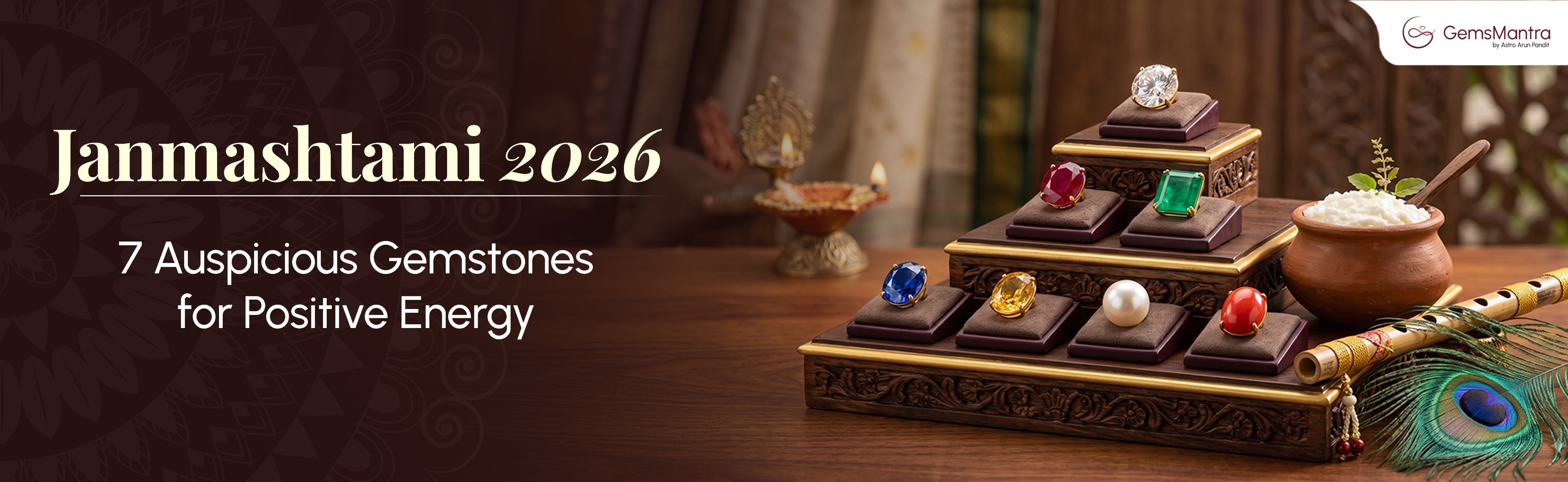
Janmashtami 2026 - 7 Auspicious Gemstones for Positive Energy
Janmashtami 2026 falls on Friday, September 4. In Vedic astrology, gemstones are traditionally linked with specific planets and Rashis. The seven key gemstones covered in this guide are Ruby, Pearl, Red Coral, Emerald, Diamond, Yellow Sapphire, and Blue Sapphire.
For those who follow Vedic astrology, Janmashtami can also be a meaningful time to learn more about gemstones and their connection with the planets and Rashis. Certain gemstones have been linked with specific planetary energies for centuries and are often selected as part of traditional astrological practices.
But choosing a gemstone is not simply about picking a beautiful stone or matching it with your Rashi.
Your Moon sign, birth chart, planetary placements, gemstone quality, and traditional wearing method can all play a role in the selection.
In this guide, we explore 7 important gemstones for Janmashtami 2026, their Rashi connections, the traditional beliefs surrounding them, and what to consider before choosing one.
Janmashtami 2026 Date and Nishita Puja Timing
Krishna Janmashtami 2026 falls on Friday, September 4.
The most important period of the celebration is Nishita Kaal, the midnight period traditionally connected with the birth of Lord Krishna.
For New Delhi, Nishita Puja is approximately from 11:57 PM on September 4 to 12:43 AM on September 5. Timings can vary depending on your location and the Panchang you follow, so it is always a good idea to check the local timings before performing the Puja.
The celebration of Janmashtami may include fasting, Krishna Puja, Abhishek, bhajans, devotional singing, and offerings to Laddu Gopal.
Dahi Handi will be celebrated on Saturday, September 5, 2026, following the main Janmashtami celebration.
Janmashtami 2026 Quick Details
· Janmashtami: Friday, September 4, 2026
· Nishita Puja: Approximately 11:57 PM – 12:43 AM in New Delhi
· Dahi Handi: Saturday, September 5, 2026
· Main deity: Lord Krishna
· Key celebration period: Nishita Kaal
Note: Puja and festival timings may differ by city and Panchang tradition.
Why Are Gemstones Connected With Rashis?
In Vedic astrology, the planets hold an important place in understanding a person’s birth chart. Each Rashi is ruled by a particular planet, and specific gemstones are linked with these planetary energies.
This is why gemstones are often selected according to a person’s Rashi and birth chart.
However, there is an important distinction between a general Rashi recommendation and a personalised gemstone selection.
Your Rashi can tell you which gemstone is traditionally connected with your ruling planet, but your complete birth chart provides much more information. Factors such as the Lagna, planetary positions, houses, aspects, and planetary strength may also be considered.
So, if you are thinking about wearing a gemstone on Janmashtami, use your Rashi as a starting point rather than the only deciding factor.
7 Auspicious Gemstones to Consider on Janmashtami 2026
From Ruby and Emerald to Yellow Sapphire and Blue Sapphire, several gemstones have an important place in Vedic astrology.
Here are seven of the most well-known options.
1. Ruby (Manik) – The Gemstone of the Sun
Ruby, known as Manik, is connected with the Sun (Surya) in Vedic astrology.
The Sun represents confidence, leadership, individuality, authority, and vitality. Ruby is therefore traditionally chosen by people looking to strengthen qualities associated with the Sun in their astrological practice.
It is linked with Simha (Leo), whose ruling planet is the Sun.
A fine Ruby is valued for its rich colour, clarity, transparency, and overall quality. If you are considering Manik for astrological purposes, your birth chart should be checked before making a final selection.
Rashi: Simha (Leo)
Planet: Sun
Gemstone: Ruby (Manik)
2. Pearl (Moti) – The Gemstone of the Moon
Soft, elegant, and naturally luminous, Pearl (Moti) has a special connection with the Moon (Chandra).
In Vedic astrology, the Moon represents emotions, sensitivity, peace of mind, nurturing qualities, and the inner world.
Pearl is traditionally connected with Karka (Cancer), which is ruled by the Moon.
Natural Pearls come in different shapes, sizes, colours, and qualities. When choosing one, both its physical characteristics and astrological suitability should be considered.
Rashi: Karka (Cancer)
Planet: Moon
Gemstone: Pearl (Moti)
3. Red Coral (Moonga) – The Gemstone of Mars
Known as Moonga, Red Coral is associated with Mars (Mangal).
Mars represents courage, determination, action, confidence, and physical energy in Vedic astrology. Red Coral is therefore traditionally selected for qualities connected with Mars.
It is linked with two Rashis: Mesha (Aries) and Vrishchika (Scorpio).
Unlike most gemstones, Red Coral is an organic gemstone rather than a crystalline mineral. Its colour, texture, surface, size, and natural characteristics are important when selecting a quality piece.
Rashi: Mesha (Aries), Vrishchika (Scorpio)
Planet: Mars
Gemstone: Red Coral (Moonga)
4. Emerald (Panna) – The Gemstone of Mercury
Emerald, or Panna, is one of the most recognised gemstones connected with Mercury (Budh).
Mercury is linked with communication, learning, intellect, analysis, business skills, and expression in Vedic astrology.
Emerald is traditionally associated with Mithuna (Gemini) and Kanya (Virgo).
When selecting an Emerald, pay attention to its colour, transparency, clarity, inclusions, treatment, and overall quality. A gemstone that looks attractive should also be carefully evaluated before purchase.
Rashi: Mithuna (Gemini), Kanya (Virgo)
Planet: Mercury
Gemstone: Emerald (Panna)
5. Diamond (Heera) – The Gemstone of Venus
Elegant and timeless, Diamond (Heera) is associated with Venus (Shukra).
In Vedic astrology, Venus represents beauty, relationships, creativity, luxury, comfort, refinement, and artistic expression.
Diamond is traditionally linked with Vrishabha (Taurus) and Tula (Libra).
When choosing a Diamond, characteristics such as cut, colour, clarity, carat weight, certification, and treatment are important. These factors can have a significant impact on the stone’s appearance and value.
Rashi: Vrishabha (Taurus), Tula (Libra)
Planet: Venus
Gemstone: Diamond (Heera)
6. Yellow Sapphire (Pukhraj) – The Gemstone of Jupiter
Golden and radiant, Yellow Sapphire (Pukhraj) is associated with Jupiter (Guru).
Jupiter is connected with wisdom, knowledge, spirituality, growth, guidance, and learning in Vedic astrology.
Yellow Sapphire is traditionally linked with Dhanu (Sagittarius) and Meena (Pisces).
When selecting Pukhraj, factors such as colour, clarity, transparency, origin, treatment, and laboratory documentation can help you evaluate the stone.
For astrological use, its suitability should also be considered in relation to the complete birth chart.
Rashi: Dhanu (Sagittarius), Meena (Pisces)
Planet: Jupiter
Gemstone: Yellow Sapphire (Pukhraj)
7. Blue Sapphire (Neelam) – The Gemstone of Saturn
Among the most recognised astrological gemstones, Blue Sapphire (Neelam) is associated with Saturn (Shani).
Saturn represents discipline, patience, responsibility, structure, perseverance, and long-term effort in Vedic astrology.
Blue Sapphire is traditionally connected with Makara (Capricorn) and Kumbha (Aquarius).
Because Neelam holds an important place in traditional gemstone astrology, it is particularly worth checking the complete birth chart before choosing it.
When purchasing a Blue Sapphire, colour, transparency, clarity, treatment, origin, and laboratory documentation are important factors to consider.
Rashi: Makara (Capricorn), Kumbha (Aquarius)
Planet: Saturn
Gemstone: Blue Sapphire (Neelam)
Rashi-Wise Gemstones for Janmashtami 2026
If you want a quick reference, here is the traditional gemstone connection for all 12 Rashis:
· Mesha (Aries): Red Coral (Moonga)
· Vrishabha (Taurus): Diamond (Heera)
· Mithuna (Gemini): Emerald (Panna)
· Karka (Cancer): Pearl (Moti)
· Simha (Leo): Ruby (Manik)
· Kanya (Virgo): Emerald (Panna)
· Tula (Libra): Diamond (Heera)
· Vrishchika (Scorpio): Red Coral (Moonga)
· Dhanu (Sagittarius): Yellow Sapphire (Pukhraj)
· Makara (Capricorn): Blue Sapphire (Neelam)
· Kumbha (Aquarius): Blue Sapphire (Neelam)
· Meena (Pisces): Yellow Sapphire (Pukhraj)
These are general Rashi-based associations. A personalised gemstone choice may require a complete birth chart analysis.
How to Choose a Gemstone for Janmashtami"
Choosing the right gemstone involves more than matching a Rashi with a stone. If you are planning to start wearing one during Janmashtami, keep these points in mind.
Check Your Birth Chart
Your Moon sign is useful, but gemstone selection can also involve your Lagna and planetary placements. A complete birth chart can provide a more personalised basis for choosing a gemstone.
Look at Gemstone Quality
Natural gemstones can vary widely in quality. Colour, clarity, transparency, cut, treatment, origin, and carat weight can all affect the appearance and characteristics of a stone.
Check Laboratory Documentation
A reliable laboratory report can provide important information about a gemstone, including its identity and relevant quality characteristics.
This is particularly useful when purchasing valuable gemstones such as Diamond, Ruby, Emerald, Yellow Sapphire, and Blue Sapphire.
Choose the Right Jewellery Setting
Your gemstone can be worn in a ring, pendant, bracelet, or other jewellery design depending on the stone and your preference.
For traditional astrological use, the recommended metal, finger, weight, day, time, and wearing method may vary from one gemstone to another.
Follow a Traditional Wearing Ritual
Some people prefer to perform a cleansing or Puja ritual before wearing a gemstone for the first time.
If you follow Vedic astrology, you can consult an experienced astrologer for the traditional method suitable for your chosen gemstone.
Certified Gemstones From GemsMantra
Choosing a gemstone is a personal decision, especially when it is being considered for astrological purposes.
At GemsMantra, you can explore a wide selection of gemstones traditionally connected with the 12 Rashis, including Ruby, Pearl, Red Coral, Emerald, Diamond, Yellow Sapphire, and Blue Sapphire.
The collection includes gemstones in different qualities, sizes, origins, and jewellery settings. Laboratory documentation is also available with applicable gemstones to help customers make a more informed choice.
If you are unsure which gemstone, size, or quality is appropriate for your astrological preferences, GemsMantra also provides access to astrological guidance to help you understand your options.
Can You Wear a Gemstone on Janmashtami?
Many people consider religious festivals such as Janmashtami an auspicious time to begin a new spiritual practice, including wearing a gemstone.
However, the festival itself does not mean that one particular gemstone is suitable for everyone.
Your Rashi can provide a starting point, while your complete birth chart can offer a more personalised direction.
If you are planning to wear a gemstone on Janmashtami 2026, take time to understand the stone, check its quality, and choose it thoughtfully.
Make Janmashtami 2026 More Meaningful
Janmashtami is a celebration of devotion, faith, and the birth of Lord Krishna. For those who follow Vedic astrology, it can also be a beautiful time to explore the traditional relationship between Rashis, planets, and gemstones.
Whether you are drawn to the deep red of Ruby, the calming beauty of Pearl, the vibrant green of Emerald, or the golden glow of Yellow Sapphire, choose your gemstone with care.
Understand your Rashi. Check your birth chart. Look for quality. And choose a gemstone that feels right for your spiritual journey.
Explore the natural gemstone collection at GemsMantra and find a gemstone suited to your preferences for Janmashtami 2026.
Written by Bhupesh Bhandari


Key Highlights
- Janmashtami 2026 Date and Nishita Puja Timing
- Why Are Gemstones Connected With Rashis?
- 7 Auspicious Gemstones to Consider on Janmashtami 2026
- Rashi-Wise Gemstones for Janmashtami 2026
- How to Choose a Gemstone for Janmashtami"
- Certified Gemstones From GemsMantra
- Can You Wear a Gemstone on Janmashtami?


