
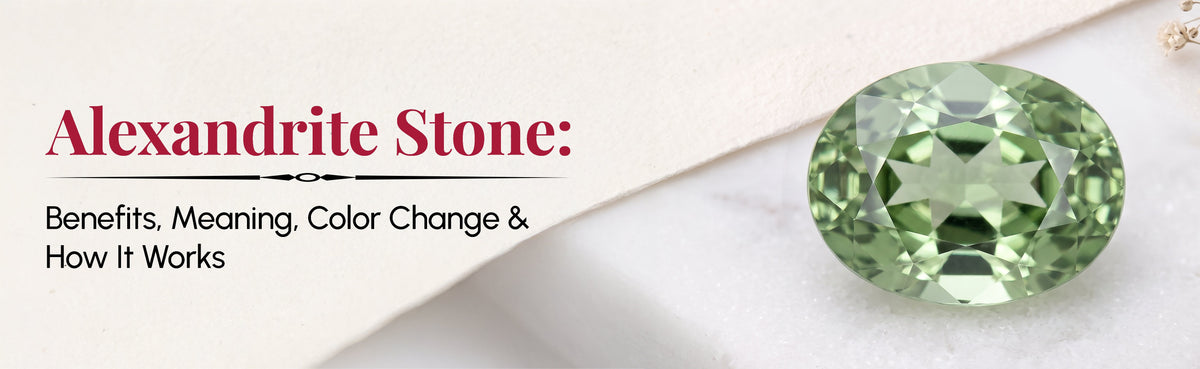
Alexandrite Stone: Benefits, Meaning, Color Change & How It Works
Quick Answer: Alexandrite is a rare variety of chrysoberyl that is famous for changing color under different lighting. It can look green or bluish-green in daylight and shift toward red or purplish-red under warm incandescent light. This effect is called the Alexandrite effect and is linked to chromium in the gemstone. Alexandrite is different from Sapphire and Emerald stone, although its green and red colors can sometimes remind people of these gemstones.
What Is Alexandrite Stone?
Alexandrite is a variety of the mineral chrysoberyl. It became famous because of its unusual ability to appear in different colors depending on the light around it.
In natural daylight, a good Alexandrite can show green, bluish-green or teal tones. Under warm artificial light, the same stone may look red, purplish-red or reddish. The change is not a trick or a coating on the surface. It is a natural optical property of the gemstone.
Alexandrite was first discovered in Russia’s Ural Mountains in the 1830s. Natural Alexandrite is now also found in places such as Brazil, Sri Lanka and East Africa, but fine natural material remains rare.
That rarity is one reason Alexandrite has become a popular choice for collectors and people looking for something different from a traditional gemstone.
Why Does Alexandrite Change Color?
This is probably the first thing most people want to know about Alexandrite.
The color change happens because of chromium present in the gemstone. Chromium affects which parts of visible light are absorbed and transmitted. Since daylight and warm incandescent light have different light characteristics, the color that reaches our eyes also changes.
So, when you take an Alexandrite from sunlight into a room with warm lighting, the gemstone itself has not suddenly changed its chemical composition. The light has changed, and the gemstone reacts differently to that light.
Scientific research has also examined the Alexandrite effect as a combination of the gemstone’s light absorption and the way the human eye interprets color under different light sources.
Alexandrite Color Change at a Glance
|
Lighting |
Common Alexandrite Appearance |
|
Natural daylight |
Green to bluish-green |
|
Cool indoor light |
Green, blue-green or mixed tones |
|
Warm incandescent light |
Red to purplish-red |
|
Candle-like warm light |
Red or reddish-purple tones |
The exact colors can vary from one stone to another.
What Are the Benefits of Alexandrite Stone?
When people search for Alexandrite stone, they may be looking for both its gemstone qualities and its traditional meaning.
From a gemstone perspective, Alexandrite offers several practical benefits:
· Its color can look different in different lighting.
· It has a Mohs hardness of about 8.5, making it suitable for jewellery.
· Natural fine-quality Alexandrite is rare.
· Its unusual color change gives jewellery a distinctive appearance.
· It can appeal to both jewellery buyers and gemstone collectors.
Alexandrite is also traditionally associated with ideas such as balance, change and adaptability. These meanings come from gemstone traditions and folklore. They should not be treated as scientifically proven effects.
For someone who simply wants a gemstone with a different look throughout the day, the color-changing feature itself is often the biggest attraction.
What Does Alexandrite Stone Mean?
The meaning of Alexandrite is closely connected with change and balance.
The reason is quite simple. The stone can appear green in one type of light and red in another. Because of this unusual quality, it has traditionally been linked with adapting to change and seeing things from different perspectives.
Alexandrite is also a June birthstone, along with Pearl and Moonstone. It is associated with the 55th wedding anniversary as well.
For many buyers, however, the meaning is personal. Some choose it because of its birthstone connection, while others simply like its rare color-changing appearance.
Is Alexandrite a Sapphire or Emerald?
No. Alexandrite, Sapphire and Emerald are three different gemstones.
Alexandrite is a variety of chrysoberyl. Sapphire belongs to the corundum family, while Emerald is the green variety of beryl.
The confusion usually comes from color.
Alexandrite can look green in daylight, which may remind someone of an Emerald stone. Under warm light, it can turn red or purplish-red, which can remind people of Ruby.
Blue Sapphire, meanwhile, is normally recognized by its blue color and does not have the same classic green-to-red color-change effect as Alexandrite.
So, although these gemstones can share certain colors, they are not the same stone.
Alexandrite vs Sapphire vs Emerald: What Is the Difference?
|
Feature |
Alexandrite |
Sapphire |
Emerald |
|
Mineral |
Chrysoberyl |
Corundum |
Beryl |
|
Famous for |
Color change |
Wide range of colors, especially blue |
Green color |
|
Common visual feature |
Green-to-red change |
Usually a consistent body color |
Green body color |
|
Mohs hardness |
8.5 |
9 |
7.5–8 |
|
Main attraction |
Color-changing effect |
Color, durability and variety |
Distinct green color |
If you like Blue Sapphire because of its deep blue appearance or Emerald because of its green color, Alexandrite offers something different: its appearance can change depending on the lighting.
How Does Alexandrite Work?
Alexandrite does not “work” by producing energy or changing itself when you move from one place to another.
Its famous effect is optical.
Chromium inside the crystal affects the way light is absorbed. Some wavelengths are absorbed more strongly than others, leaving certain colors to reach the eye. When the light source changes, the balance of those colors changes too.
That is why the same Alexandrite can look green outside during the day and reddish under a warm indoor lamp.
This color-changing effect is real and measurable. The traditional meanings associated with the stone are a separate matter.
Is Alexandrite a Rare Gemstone?
Yes, natural fine-quality Alexandrite is rare, especially when the stone has a strong and attractive color change.
Not every Alexandrite shows the same level of color change. Some stones may show a clear green-to-red transition, while others may have a softer or less noticeable shift.
According to GIA, the extent of color change and the quality of the green and red colors are important factors when evaluating Alexandrite.
This is why simply looking at the carat weight is not enough when comparing Alexandrite stones.
How Do You Choose a Good Alexandrite Stone?
If you are planning to buy Alexandrite, don’t judge it under just one light.
1. Check the Color Change
This is the first thing to look at. View the gemstone in daylight and then under warm artificial light.
A noticeable green-to-red or green-to-purplish-red change is the feature most buyers look for.
2. Check the Clarity
Clarity also matters. Fine Alexandrite is often relatively clean to the eye, although natural gemstones can contain inclusions.
3. Look at the Cut
A good cut helps the gemstone return light properly and can make its color and color change easier to see.
4. Ask Whether It Is Natural or Lab-Grown
Natural and laboratory-grown Alexandrite should be clearly disclosed. They can both show a color-change effect, but their origins are different.
For an expensive purchase, an independent gemstone report can provide useful information about the stone.
5. See the Stone in More Than One Light
This simple step is especially important with Alexandrite. A photograph taken under one light cannot always show how the stone will look in another environment.
Is Alexandrite Good for Jewellery?
Yes. With a Mohs hardness of 8.5, Alexandrite is considered a durable gemstone for jewellery. It can be used in rings, pendants, earrings and other designs.
Still, like other gemstones, it should be handled carefully and cleaned properly. Mild soapy water and gentle handling are commonly recommended for routine cleaning.
Is Alexandrite Better Than Sapphire or Emerald?
There is no single answer because these gemstones have different features.
If you want a gemstone known for a color-changing effect, Alexandrite has a very different appeal.
If you prefer a classic blue gemstone, Blue Sapphire may be more suitable to your taste.
If you want a traditional green gemstone, an Emerald stone has its own distinct appearance.
The right choice depends on the color, gemstone type, jewellery design and characteristics you prefer.
Final Thoughts
Alexandrite is a gemstone that can look surprisingly different from one lighting condition to another. Its green-to-red color change, natural rarity and good durability make it an interesting option for jewellery and gemstone collections.
If you are considering an Alexandrite from GemsMantra, pay attention to the color change, clarity, cut, gemstone origin and available certification. Most importantly, view the stone under different types of lighting before making your choice.
Written by Bhupesh Bhandari


Key Highlights
- What Is Alexandrite Stone?
- Why Does Alexandrite Change Color?
- What Are the Benefits of Alexandrite Stone?
- What Does Alexandrite Stone Mean?
- Is Alexandrite a Sapphire or Emerald?
- How Does Alexandrite Work?
- Is Alexandrite a Rare Gemstone?
- How Do You Choose a Good Alexandrite Stone?
- Is Alexandrite Good for Jewellery?
- Is Alexandrite Better Than Sapphire or Emerald?


