
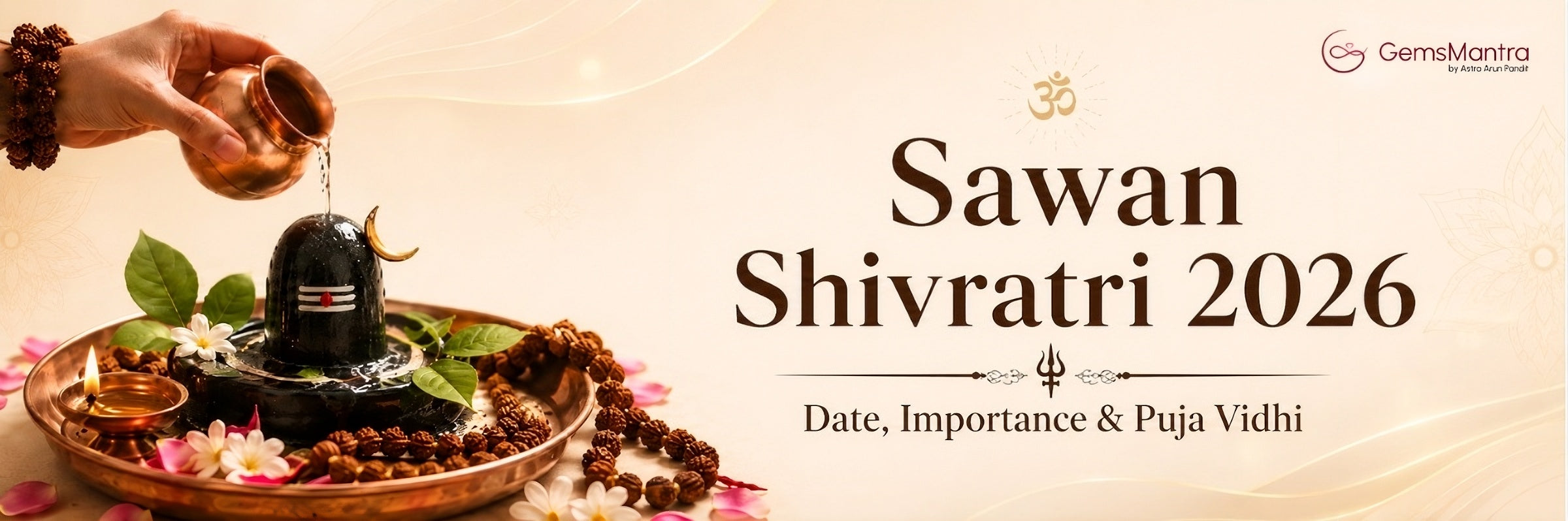
Sawan Shivratri 2026 - Date, Importance & Puja Vidhi
Sawan Shivratri 2026 falls on Tuesday, August 11 - the Maas Shivratri occurring inside Lord Shiva’s own month, making it the most spiritually powerful night of Sawan 2026. Whether you are observing a simple fast, performing jalabhishek, or starting a new Rudraksha for the first time - this guide covers everything: the date, Nishita Kaal timing, puja vidhi, mantras, and which Rudraksha to begin on this night.
What is Sawan Shivratri 2026 - and when does it fall?
Sawan Shivratri 2026 falls on Tuesday, August 11, 2026 - the Chaturdashi tithi (14th day) of the Krishna Paksha (dark fortnight) of Shravan month. It is also known as Maas Shivratri or Shravan Shivratri.
Every month carries a Maas Shivratri on the Krishna Chaturdashi. But the one falling inside Sawan is different - because Sawan is entirely Lord Shiva’s month. Every act of worship during Shravan carries heightened spiritual weight, and the Shivratri within it is considered the most potent monthly Shivratri of the year.
Key timings for Sawan Shivratri 2026:
|
Date |
Tuesday, 11 August 2026 |
|
Tithi |
Shravana Krishna Chaturdashi |
|
Nishita Kaal (peak worship window) |
12:02 AM – 12:48 AM (early hours of 12 August) |
|
Parana - fast breaking |
Morning of 12 August, after Chaturdashi ends |
The Nishita Kaal - the midnight window when Shiva’s presence is traditionally held to be strongest - runs for only 46 minutes. If you can observe a single sincere abhishek during this window, this is the moment to do it.
What is the difference between Sawan Shivratri and Maha Shivratri?
Maha Shivratri (in Phalguna - February or March) is Shiva’s great night for the entire year - the night of his cosmic dance, observed by all Shiva devotees universally.
Sawan Shivratri is the Maas Shivratri falling within Shiva’s own month. It does not carry the same universal scale - but in Vedic tradition it is considered more personally intimate. Puja performed on this night, inside the month Shiva himself presides over, is traditionally believed to carry the merit of a lifetime of regular worship.
In simpler terms: Maha Shivratri is Shiva’s night for the world. Sawan Shivratri is Shiva’s night within his own home.

Sawan Shivratri is also the ideal night to begin wearing a Rudraksha for the first time - or to perform puja with a Rudraksha Mala for the first time. The bead’s connection to Lord Shiva makes this night its most traditional and auspicious starting point in the entire year.
Why is Sawan Shivratri 2026 especially powerful?
Three factors combine to make August 11 especially auspicious this year:
1. It falls on a Tuesday (Bhaum). Tuesday is governed by Mars (Mangal) - the planet of courage, energy, and decisive action. The combination of Shiva’s Shivratri night and Mars energy creates a particularly strong window for protection, strength, and new beginnings.
2. It coincides with Mangala Gauri Vrat. August 11 is one of the four Mangala Gauri Tuesdays of Sawan 2026 (August 4, 11, 18, 25) - observed by newly married women for the health, longevity, and prosperity of their husbands. For married women, this night holds a double significance.
3. Kanwar Yatra culminates on this night. Sawan Shivratri is the traditional final offering point of the Kanwar Yatra - millions of Kanwariyas carry Ganga jal hundreds of kilometres to pour over the Shivling specifically on this night.
For those preparing their home puja for this night, GemsMantra’s Pooja Kit includes a Rudraksha Activation Kit and Premium Pooja Thali Set - everything you need for a complete Sawan Shivratri puja at home.
Which Rudraksha to begin on Sawan Shivratri 2026?
Sawan Shivratri is one of the most auspicious nights to wear a Rudraksha for the first time. The Shiva Purana and Devi Bhagavata Purana both state that no Shiva puja is complete without the worshipper wearing Rudraksha - and beginning a bead on Shivratri within Sawan carries the highest traditional significance.
Choose based on your goal:
|
Goal |
Rudraksha |
Association |
|
Peace & daily well-being |
5 Mukhi |
Panchmukhi Shiva - universal bead for everyone |
|
Wealth & business growth |
7 Mukhi |
Goddess Mahalakshmi & Saturn |
|
Obstacle removal |
8 Mukhi |
Lord Ganesha & Rahu |
|
Career & willpower |
6 Mukhi |
Lord Kartikeya & Venus |
|
Couples & marriage |
Gauri Shankar |
Shiva-Parvati - ideal for Sawan Shivratri |
|
Protection & strength |
9 Mukhi |
Goddess Durga & Ketu |
In Vedic tradition, these associations reflect the bead’s ruling deity and planet - individual results vary.
Not sure which Mukhi suits your Rashi?
Use the free Rudraksha Calculator - personalised recommendation in seconds
At GemsMantra, founded by Astro Arun Pandit with 50 years of Vedic legacy, every Rudraksha is X-ray verified - the scan confirms the internal seed chambers match the Mukhi count - and ships with a verifiable Gemtrue/IGL/ISO certificate. Trusted by 1 lakh+ customers across India and 150+ countries. Every prepaid order this Sawan is energised through a group Rudrabhishek on each Sawan Somvar - your name is included in the sankalp and the ritual video is shared on WhatsApp. Browse the Sawan Special 2026 collection for curated Rudraksha beads and combos.

How to begin on Sawan Shivratri night:
Cleanse the Rudraksha with Gangajal. Hold it in your right palm during puja. Chant “Om Namah Shivaya” 108 times. Wear it immediately after - ideally during or just after the Nishita Kaal.
Individual results vary - these are traditional Vedic beliefs, not guaranteed outcomes.
How to perform Sawan Shivratri puja at home - step by step
You do not need a temple to observe Sawan Shivratri meaningfully. A sincere home puja is completely valid in Vedic tradition. Here is the complete vidhi:
Step 1 - Purification (Brahma Muhurat) Wake before sunrise. Bathe and wear clean, white or light-coloured clothes. Clean your puja space thoroughly.
Step 2 - Sankalp Hold water and flowers in your right palm. State your name, gotra (family lineage), and your intention for the vrat. Pour the water into a vessel. This is your commitment to Lord Shiva for the night.
Step 3 - Jalabhishek Pour clean water or Gangajal slowly over the Shivling while chanting “Om Namah Shivaya” continuously. This is the most fundamental act of Sawan worship - offering cooling water to Shiva, who swallowed the halahal poison during Samudra Manthan to protect the universe, and is therefore called Neelkanth.
Step 4 - Panchamrit Abhishek Offer the five sacred items one by one over the Shivling: 1. Raw milk - purity 2. Curd - prosperity 3. Ghee - longevity 4. Honey - wisdom 5. Sugar or misri - happiness
Rinse the Shivling with clean water after Panchamrit.
Step 5 - Shringar (Adornment) Apply white chandan (sandalwood paste). Offer Bilva patra (Bel leaves) - the Shiva Purana places this above all other offerings to Shiva. Also offer Dhatura flowers, white flowers, and Akshat (unbroken rice).
Step 6 - Mantra Jaap Chant “Om Namah Shivaya” 108 times. For Sawan Shivratri, also chant the Mahamrityunjaya Mantra a minimum of 11 times - ideally 108 times at the Nishita Kaal:
ॐ त्र्यम्बकं यजामहे सुगन्धिं पुष्टिवर्धनम् उर्वारुकमिव बन्धनान्मृत्योर्मुक्षीय माऽमृतात्
Step 7 - Katha & Aarti Read or listen to the Sawan Somvar Vrat Katha. Conclude with the Shiva Aarti (“Om Jai Shiv Omkara”) while lighting a ghee diya.
Step 8 - Nishita Kaal Puja (12:02 AM – 12:48 AM) Perform your main abhishek and aarti during this 46-minute midnight window - the peak of the entire night.
Step 9 - Parana (fast breaking) Break the fast the next morning - August 12 - after the Chaturdashi tithi ends, after taking darshan and prasad.
Can women observe Sawan Shivratri vrat?
Yes - completely. There is no restriction on women observing Sawan Shivratri.
In Vedic tradition, Parvati herself fasted during Sawan to attain Lord Shiva as her husband. Unmarried women observing this fast follow the same precedent. Married women seek blessings for their husband’s health and long life - and in 2026, the Mangala Gauri Vrat also falls on August 11, making this night especially significant for married women.
Women can also begin wearing Rudraksha on Sawan Shivratri. The Gauri Shankar Rudraksha - a naturally joined double bead representing Shiva and Parvati - is traditionally the most recommended for married women during Sawan.
Frequently Asked Questions
Q1. What is the date of Sawan Shivratri 2026? Sawan Shivratri 2026 falls on Tuesday, August 11, 2026 - Krishna Chaturdashi of Shravan month. The Nishita Kaal runs from 12:02 AM to 12:48 AM on August 12. Fast breaks the morning of August 12 after the tithi ends.
Q2. What is the difference between Sawan Shivratri and Maha Shivratri? Maha Shivratri (February–March) is Shiva’s great night for the whole year. Sawan Shivratri is the monthly Shivratri within Shiva’s own month - more intimate and traditionally believed to carry the merit of a lifetime of worship.
Q3. Can I perform Sawan Shivratri puja at home? Yes - a sincere home puja with Gangajal, Bilva patra, and Om Namah Shivaya chanting is completely valid. Sincerity carries more weight in Vedic tradition than elaborate ceremony. Follow the 9-step vidhi above.
Q4. Which Rudraksha is best to start on Sawan Shivratri? The 5 Mukhi is universally recommended - suitable for all ages and genders. For wealth, choose 7 Mukhi. For couples, Gauri Shankar. Begin wearing after the puja, ideally at the Nishita Kaal. Individual results vary - these are traditional Vedic beliefs.
Q5. What mantra should I chant on Sawan Shivratri? Chant “Om Namah Shivaya” 108 times on a Rudraksha Mala through the day and evening. During the Nishita Kaal, chant the Mahamrityunjaya Mantra a minimum of 11 times - ideally 108 times.
Written by Shivani Saini


