
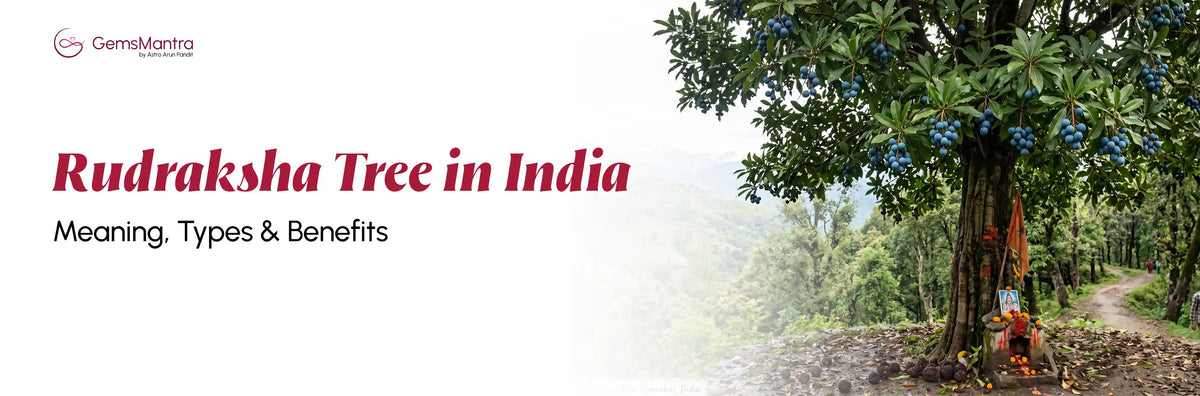
Rudraksha Tree in India: Meaning, Types & Benefits
Quick answer: The rudraksha tree (Elaeocarpus ganitrus) is a tall evergreen tree whose blue fruits hold the seed that becomes the rudraksha bead. In India it grows mainly in warm, humid areas such as the Himalayan foothills and the north-east, while most beads sold in India come from Nepal and Indonesia. It is sacred to Lord Shiva in Hindu tradition, and it can be grown at home if you have outdoor space and a suitable climate.
The Rudraksha tree is a very popular tree in India because of its cultural and spiritual connection. The seeds are found in its fruit, and are made into beads in Rudraksha. These beads are connected with Lord Shiva as well. You will find them in malas and spiritual practices in prayer.
Many people wonder whether the Rudraksha tree grows in India. If yes, then can they be planted at home? You may want to grow it for religious reasons, or if you want to plant a unique tree.
A Rudraksha tree is also loved for its natural beauty, peaceful shade, and spiritual value. People who feel connected to rudraksha beads often find planting this tree meaningful. You can also use a Rudraksha Calculator to choose the right Rudraksha for yourself. In this guide, you’ll learn everything about the Rudraksha tree, its benefits, and other important details.
What is Rudraksha Tree?
A Rudraksha tree is the tree from which Rudraksha seeds are obtained. The tree bears fruit after it matures and carries a seed inside. This seed is dried and later used to make spiritual items.
The tree grows in tropical and sub-tropical regions. It begins producing fruits with a blue outer layer. The seed found inside the fruit later becomes the Rudraksha bead.
The word Rudraksha comes from two Sanskrit terms, called Rudra and Aksha. In Hindu tradition, it is associated with Lord Shiva and is therefore, very sacred.
Many people take an interest in knowing about the Rudraksha tree across India and abroad because of this cultural connection.
Interested in knowing more about Rudraksha beads, read our detailed article on what are rudraksha beads.

Rudraksha Tree Benefits
The Rudraksha tree benefits are practical and cultural.
Cultural and Spiritual Importance
-
It is considered holy in hindu rituals
-
It is planted near temples or spiritual places
-
It is appreciated by devotees of Lord Shiva
-
It is connected with traditional practices
Environmental Value
-
Adds greenery to open spaces
-
Can provide shade after maturity
-
May support birds and local biodiversity
-
Useful as a long-living tree in gardens or farms
Personal Preference
-
Chosen by many people for home gardens
-
Appreciated for its symbolic value
-
Included in meditation or prayer spaces
History, Significance and Importance of Rudraksha Tree
The Rudraksha tree holds a great significance in Hindu customs and spirituality. In ancient traditions, Rudraksha beads are associated with Lord Shiva. They are said to have been made from his tears, and are therefore regarded as holy. Rudraksha has been an integral part of meditation and spiritual practices for ages.
The spiritual benefit of the rudraksha tree is its importance. The beads are typically used in malas for chanting and meditation. There are many people who believe that Rudraksha when worn or used assists in bringing peace, focus and a sense of balance in daily life.
The spiritual relevance of the Rudraksha tree is equally great as the practical. It is often utilized by people who want to establish a disciplined habit, improve their attention and maintain a connection with their spiritual activities. Rudraksha is still valued now for its ancient use and for its current living demands.
 Different Types of Rudraksha Beads
Rudraksha beads are classified based on the number of natural lines or “mukhis” present on each bead. Each Rudraksha type is believed to have a different significance and purpose.
|
Type of Rudraksha |
Traditional association |
|
Aids in intense attention and spiritual growth |
|
|
Enhances relationships and balance |
|
|
Builds confidence and reduces previous tension |
|
|
Helps learning and communication |
|
|
Provides calmness and daily balance |
|
|
Improves focus and discipline |
|
|
Linked with financial stability |
|
|
Helps overcome obstacles |
|
|
Supports strength and protection |
|
|
Known for protection and reducing fear of negativity |
|
|
Supports decision making and inner strength |
|
|
Linked with confidence, authority and leadership |
|
|
Associated with attraction, charm and fulfillment of desires |
|
|
Helps improve intuition and decision-making ability |
|
|
Supports emotional balance and inner peace |
|
|
Known for protection from losses and fear |
|
|
Linked with success, growth and new opportunities |
|
|
Associated with stability, patience and grounded energy |
If you are interested, you can also explore other Rudraksha collection available with us, including 22 to 27 Mukhi beads, as well as Gauri Shankar, Natural Garbh Gauri Shankar, and Ganesh Rudraksha, depending on your needs and preferences.
If you want to learn more about each, read our detailed article on 1 to 21 mukhi rudraksha.
Where does the rudraksha tree grow in India?
The rudraksha tree prefers a warm, humid climate with good rainfall and deep, well-drained soil. In India it is found mainly in the Himalayan foothills, including parts of Uttarakhand, and in the north-east, including Assam. Many temples and gardens elsewhere also grow it for its religious value. Most rudraksha beads sold in India, however, come from Nepal and from Indonesia (Java): Nepali beads are usually larger with deeper lines, and Indonesian beads are smaller and lighter.
| Growing condition | What the tree prefers |
|---|---|
| Climate | Warm and humid; young plants need protection from frost and harsh dry heat |
| Light | Full sun to light shade outdoors |
| Soil | Deep, fertile, well-drained soil with compost |
| Water | Regular watering, without waterlogging |
| Space | A large open area, because it grows into a tall tree |
Scientific Name and Characteristics of Rudraksha Tree
The scientific name of the Rudraksha tree is Elaeocarpus ganitrus. It is an evergreen tree with a broad canopy, and it grows quite tall.
|
Feature |
Details |
|
Height |
40 to 80 feet in open areas |
|
Leaves |
Long, green, slightly pointed |
|
Flowers |
Small white or pale green |
|
Fruit |
Round with a blue outer layer |
|
Seed |
Rudraksha bead inside |
The tree may grow slowly in the early years and become stronger as it ages. A healthy tree can live for many decades.
The fruits appear after maturity. They are dried, and the seed inside is separated to use it as a Rudraksha bead.
How to Identify an Original Rudraksha Tree
There are visible features on the original Rudraksha tree that help in identification.
|
Identification Point |
Details |
|
Leaves |
Green, smooth, slightly pointed |
|
Flowers |
Small and light coloured |
|
Fruit Colour |
Blue when ripe |
|
Fruit Shape |
Round to oval |
|
Tree Type |
Tall evergreen tree |
The fruit is one of the easiest signs to notice. Its blue outer layer makes it stand out.
Most confusion in the market happens while buying beads after seeds are harvested.
 Sample image
When you buy a bead rather than grow a tree, the check is different: count the natural lines, make sure nothing is carved, glued or filled, and buy where each order comes with a report you can verify. Every GemsMantra order ships with a GemsMantra Authenticity Report whose number you can check on our Check Certificate page, and eligible beads can add an optional X-ray certificate. Our real vs fake rudraksha guide explains the checks.
 Can We Grow Rudraksha Tree at Home?
Many people ask, "Can we grow a Rudraksha tree at home?” It is possible if you have enough outdoor space and a suitable climate.
A Rudraksha tree grows tall with time, so it is better suited for growing in the following spaces:
-
Gardens
-
Farmhouses
-
Open land
-
Large courtyards
It cannot be a permanent indoor plant. Small pots are helpful during early growth, but later the tree needs more space to mature.
This tree prefers sunlight, moist soil, and open air. You may have to care for it more if you plant it in hot or dry regions.
How to Grow a Rudraksha Tree?
If you want to know how to grow a Rudraksha tree, the following steps can help:
-
Choose Seeds or Saplings
Plant fresh seeds of ripe fruit or purchase disease-free nursery saplings. Beginners seem to grow saplings much easier.
-
Prepare the Soil
Plant in fertile and well drained soil combined with compost.
|
Soil Need |
Best Option |
|
Texture |
Loose and rich |
|
Drainage |
Good |
|
Organic Matter |
Compost mixed |
-
Select the Right Spot
It needs natural sunlight, and a big area to grow its tree. Select such an area outside.
-
Water Regularly
Keep soil moist, but do not water too much. Young plants need more attention.
-
Protect Early Growth
Fencing can protect the small plant if there are animals nearby. Avoid using harsh chemicals.
-
Be Patient
The tree may grow slowly in its early years. So, fruiting can take several years, depending on climate and care.
 Rudraksha Tree vs Rudraksha Beads
Many people confuse the tree and the bead.
|
Rudraksha Tree |
Rudraksha Beads |
|
Living tree |
Seed from fruit |
|
Grows for decades |
Used in malas or accessories |
|
Produces fruits |
Used in spiritual traditions |
|
Needs soil and care |
Needs an authenticity check |
You can take expert guidance if you plan to wear one to understand mukhi types and suitability.
Interested in knowing your rudraksha compatibility? Read our blog on Rudraksha and zodiacs.
Lifespan and Growth of Rudraksha Tree
The original Rudraksha tree is considered a long-living tree.
-
Early years: Slower root and stem development
-
Middle years: Faster height growth
-
Mature stage: You may notice flowering and fruiting
-
Older stage: Large canopy with recurring fruit cycles
Many trees may begin fruiting after 5 to 8 years, depending on region, climate, and maintenance.
Why Plant a Rudraksha Tree?
Planting a Rudraksha tree can be meaningful for many people.
Common Reasons
-
Adds a unique tree to the property
-
Adds greenery in open spaces
-
It is connected with religious tradition
-
A long-living tree for future generations
-
Popular among people interested in the Rudraksha culture
Many people also plant it during special family or religious occasions. It is advisable to consult an astrologer to compare Rudraksha and gemstones based on your birth chart and get proper guidance on spiritual remedies.
Frequently asked questions
Where is the rudraksha tree found in India?
The rudraksha tree grows in warm, humid regions. In India it is found mainly in the Himalayan foothills, including parts of Uttarakhand, and in the north-east, including Assam. Most rudraksha beads sold in India come from Nepal and from Indonesia (Java).
What is the scientific name of the rudraksha tree?
The rudraksha tree is Elaeocarpus ganitrus, a tall evergreen tree. Its round fruits turn blue when ripe, and the seed inside becomes the rudraksha bead.
Is rudraksha a seed or wood?
Rudraksha is a seed, not wood. It is the hard stone inside the blue fruit of the rudraksha tree, dried and cleaned before it is worn.
Can I grow a rudraksha tree at home?
Yes, if you have outdoor space and a warm, humid climate. It grows into a tall tree, so it suits gardens, farms and large courtyards rather than a permanent pot indoors.
Is it good to keep a rudraksha tree at home?
In Hindu tradition the rudraksha tree is considered sacred to Lord Shiva, so many families see planting one as auspicious. Practically, make sure you have room for a large tree.
How long does a rudraksha tree take to give fruit?
Many trees begin fruiting after about 5 to 8 years, depending on region, climate and care.
How can I tell if a rudraksha bead is real?
Check that the natural lines (mukhis) run unbroken from top to bottom with no carving or glue, and buy where each order comes with a report you can verify. See our real vs fake rudraksha guide.
Conclusion
The Rudraksha tree is valued not only for its connection with Rudraksha beads and Lord Shiva, but also for its natural beauty, greenery, and long lifespan. Many people choose to plant it in gardens, farms, or open spaces because of its cultural and spiritual importance. With the right climate, sunlight, and care, the tree can grow well in many parts of India and become a meaningful addition for future generations.
If you are interested in wearing Rudraksha beads, it is important to choose authentic ones based on your needs and birth chart. You can also use a Rudraksha Calculator or consult an astrologer for proper guidance. At GemsMantra, you can explore a wide range of authentic Rudraksha beads suitable for different preferences and spiritual practices.
Read next: the 13 rarest rudraksha beads, our guide on how to wear rudraksha, or browse the natural rudraksha collection.
Frequently Asked Questions
Rudraksha trees that are original grow in Uttarakhand, Sikkim, Assam, Meghalaya, Arunachal Pradesh and certain areas of the Himalayan foothill. These regions provide the climate and rainfall that are favorable to development.
The original Rudraksha tree bears green pointed leaves, light coloured small flowers and blue ripe fruits. The grain then is the Rudraksha bead within the fruit.
The real Rudraksha trees are cultivated in Uttarakhand, Sikkim, Assam and Meghalaya and Arunachal Pradesh. There are some adjacent areas with the same weather patterns that might support growth.
The scientific name of Rudraksha tree is Elaeocarpus ganitrus. It is a tree that is evergreen and produces the seeds that are used as Rudraksha beads.
Rudraksha trees are also good in warm and wet climates with frequent rainfalls. Preference is usually the well-drained, fertile soil and moderate temperatures.
In India and Nepal, rudraksha trees are of the same extended family. A little bit of variation in the bead size or outer appearance may be brought about by climate and region.
Purchase beads from reliable sellers who give product specifications or certifications where necessary. Mukhi lines and bead quality checking can also be done with the help of an expert.
Rudraksha trees are commonly planted by many people as a source of greenery, shade, and cultural importance. It is also valued as a long-lived tree for gardens and open areas.
When planted under the right conditions, a healthy Rudraksha tree can take decades to live. With proper attention the mature trees can grow and bear fruit over years.
A Rudraksha tree can be cultivated on a sapling in good health, soil and sunlight outside. During early growth, it is important to water, spacings, and be patient.
Written by Vineet Kumar


%20is%20a%20tall%20evergreen%20tree%20whose%20blue%20fruits%20hold%20the%20seed%20that%20becomes%20the%20rudraksha%20bead.%20In%20India%20it%20grows%20mainly%20in%20warm,%20humid%20areas%20such...)

Key Highlights
- What is Rudraksha Tree?
- Rudraksha Tree Benefits
- History, Significance and Importance of Rudraksha Tree
- Where does the rudraksha tree grow in India?
- Scientific Name and Characteristics of Rudraksha Tree
- How to Identify an Original Rudraksha Tree
- How to Grow a Rudraksha Tree?
- Lifespan and Growth of Rudraksha Tree
- Why Plant a Rudraksha Tree?
- Frequently asked questions
- Conclusion


